Guides ›
How to Merge Games With AI: Merge Puzzles, Game Mashups and Your First Build
What "merging games" means today – merge-two puzzles and AI-built game mashups – how the mechanics work, strategy that wins, and a step-by-step way to build or remix a merge game with an AI assistant.
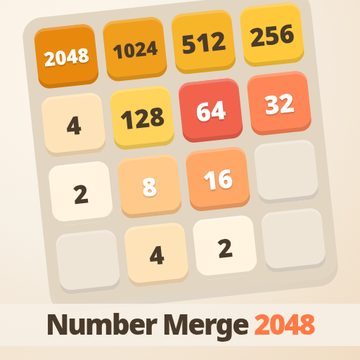 Number Merge 2048: Slide & Merge PuzzleSlide numbered tiles, merge equal pairs and build the 2048 tile — with undo and 4 themes.▶ Play Number Merge 2048 free
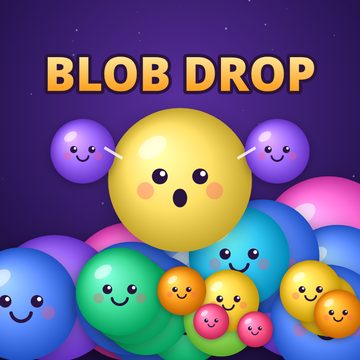 Blob Drop: Merge PuzzleDrop blobs, merge matching ones and reach the Galaxy Blob.▶ Play Blob Drop free
- Meaning 1
- Merge puzzle – two equal pieces combine into the next level
- Meaning 2
- Game mashup – a mod that joins two existing games into one
- Play a merge puzzle now
- Number Merge 2048 · Blob Drop
- Build with AI
- One HTML file, your own code and art, one rule change at a time
- Cost here
- Free, no download, no account
Two things people mean by "merge games"
The phrase now covers two very different things, and most pages only explain one of them.
The first is the merge puzzle: a casual game where two identical pieces combine into one piece of the next level. Number tiles that add up, fruit or blobs that grow when they touch, or items on a board that upgrade when you drag one onto its twin. You can play two of ours right now: Number Merge 2048, a sliding grid of numbers, and Blob Drop, a physics drop-and-merge jar.
The second is the game mashup: a mod that joins two existing games, for example one game's character moving through another game's world. In 2026 these became popular because AI coding agents can now write much of the glue code that lets two games talk to each other. That is where searches such as "how to merge games with AI" and "melty game merge" come from.
This guide covers both: how merge puzzles work and how to get better at them, what a mashup actually involves, and – the part most guides skip – how to build or remix your own merge game with an AI assistant, safely and without touching anyone else's files.
How merge mechanics work
Every merge puzzle, whatever it looks like, is built from the same five parts. Knowing them makes you a better player and, if you build one, a better designer.
1. The merge rule. Two pieces of the same level combine into one piece of the next level. In 2048 that is 2 + 2 = 4, 4 + 4 = 8 and so on. In Blob Drop, two touching blobs of one size become one blob of the next size.
2. The ladder. There is a fixed list of levels. Number Merge 2048 climbs the powers of two to 2048 and beyond; Blob Drop has 11 blob levels from Dot to Galaxy Blob (see all 11).
3. The spawn table. Only the lowest levels ever appear on their own. In our 2048 a new tile is a 2 nine times out of ten and a 4 the rest of the time; in Blob Drop only the five smallest blobs come out of the dropper. Everything bigger exists only because you merged it.
4. Space pressure. Each new piece takes up room, and each merge frees room. The whole game is a race between the two.
5. The end condition. A full grid with no possible move (2048), or a container that overflows (drop-and-merge games). A fair end rule matters: in Blob Drop a blob has to sit above the line for about 2.2 seconds before the round ends, so a single bounce is forgiven.
Grid, physics or board – the three families
Grid merge games (2048-style) are pure logic: one swipe moves every tile, and nothing is random except where the next tile appears. You can think as long as you like over each move.
Physics merge games (drop-and-merge) add gravity and collisions. Pieces roll, bounce and push each other, so the same plan can play out differently each time. Our explainer on drop-and-merge games goes deeper.
Board merge games let you drag items onto matching items to build a garden, a house or a shop. Sessions are longer and are often paced with energy or timers. For a quick comparison of all three, see Best Free Merge Games Online.
Strategy that works in almost every merge game
Keep your biggest piece in one corner. A big piece in the middle blocks merges on every side; in a corner it blocks only two. This is the heart of the 2048 corner method and works just as well in a drop jar.
Build a ladder away from it. Line pieces up in falling order – 256, 128, 64, 32 in 2048, or big, medium, small blobs in a jar – so each new merge happens right next to its next partner and can set off a chain.
Never bury a big piece. A small piece sitting on top of a large one can block it for a long time. Put small pieces on the far side, where the small levels live.
Read the next piece. Blob Drop shows the next blob in the NEXT box; use it to decide where the current one should go.
Count your free space. In 2048 a move without a merge costs you one empty cell, because a new tile always appears; one merge keeps the count level and two merges win a cell back. When space runs low, prefer moves that merge something.
Use your safety net on real mistakes only. Number Merge 2048 gives 3 undos per game on the 4×4 and 5×5 boards and 5 on the 3×3 board. Save them for the swipe that pulls your corner tile out, not for an unlucky spawn.
What a game mashup involves
A mashup takes one part of a game – a character, a mechanic, a map – and makes it work inside another game. Some are classic hand-built mods; the new wave is built with AI coding agents that read both games' mod tools and write the code that joins them.
One app built around this is Melty (melty.gg), a free PC app. Its own site describes a mashup as "a mod that joins games into one", says mashups run on games you already own, and says you can make one by giving a coding agent Melty's instructions. Its terms say the app finds your installed games, downloads mod tools and writes into your game folders, keeping copies of replaced files so it can restore them, and they warn that some games' rules, anti-cheat or online services do not allow mods. We have not tested it; read its current pages before installing.
Whatever tool you use, the same rules apply to PC mashups: you need your own legitimate copy of every game involved; owning a game does not give you the right to share its files or art; keep mods out of online and anti-cheat-protected play unless the publisher allows it; and back up your saves first.
The no-install way: build your own merge game with AI
You do not need to mod anyone's game to make a merge game. A small merge puzzle is one of the best first projects for an AI coding assistant, because the rules are short and easy to test. Any AI chat or coding assistant that can write JavaScript works, and the result runs in a browser.
Step 1 – write a one-paragraph spec before you prompt. Decide the five parts from the section above: the merge rule, the ladder (how many levels and what they look like), the spawn table (which levels can appear on their own and how often), what frees space, and exactly when the game ends.
Step 2 – ask for one self-contained HTML file with the graphics drawn in code (shapes and emoji, no image files). That keeps the game small, avoids borrowing anyone's art and lets you open it by double-clicking.
Step 3 – play it for five minutes and write down what feels wrong. Then ask for one change at a time, so you know which change helped.
Step 4 – only then add the extras: score, a next-piece preview, sounds, saving, a best score.
A prompt you can copy
Use this as a starting brief and change the parts in capitals:
"Build a single-file HTML5 merge puzzle with no external files. The board is a GRID OF 5×5 CELLS. Each turn the player DROPS A PIECE INTO A COLUMN; it falls to the lowest free cell. When two pieces of the same level touch, they merge into one piece of the next level in the cell of the piece that just landed, and the merge can chain. There are 8 LEVELS drawn as coloured circles with the level number. New pieces are level 1 (70%), level 2 (25%) or level 3 (5%). Show the next piece. The game ends when a piece cannot be placed. Score = value of every merged piece. Support touch, mouse and arrow keys, prevent page scrolling while playing, and save the best score in localStorage. Comment the merge function so I can change the rules later."
Asking for the rules as numbers (board size, level count, spawn chances) is what makes the result tunable: next time you only change a number instead of rewriting the prompt.
Remixing two mechanics into one merge game
The legal, beginner-friendly version of "merging two games" is merging two mechanics in your own code. Pick a merge rule, pick one rule from a different kind of game, and write one sentence that joins them. Good joining rules change how you win, not just how it looks:
Gravity + number tiles: tiles fall into columns instead of sliding, so a drop can set off a chain of sums.
Merge + stacking: every merge drops a block onto a tower at the side, and the round ends if the tower falls. (Our stacking game Pet Tower shows how a one-tap drop feels.)
Merge + daily goals: three small goals a day, such as "make a level-6 piece" or "get a ×3 combo", like the daily goals in Blob Drop.
Merge + a timer that refills: each merge adds a second to the clock, turning a calm puzzle into a fast one.
Describe the mechanic in your own words instead of "make it like GAME X". You get a more original game, and you avoid copying someone else's names, art and level design.
Bugs AI-built merge games usually have (and how to ask for the fix)
Double merges. Three equal pieces touching at once merge twice, or one piece merges with two partners in the same moment. Ask: "Each piece may merge at most once per step; resolve merges in a fixed order." In 2048 this rule is why 2, 2, 2, 2 swiped left gives 4, 4 and not 8.
A game over that comes too soon. A piece bounces above the line for a moment and the round ends. Ask: "Only end the game if a piece has rested above the line for 2 seconds."
Shaking piles in physics versions. Ask for a fixed physics time step and for nearly still pieces to be allowed to settle.
Moves that change nothing still add a piece. Ask: "If a move changes nothing on the board, do not spawn a new piece."
The page scrolls on phones while swiping. Ask for touch events on the board to prevent default scrolling.
Progress lost on refresh. Ask for the board and score to be saved in localStorage after every move.
Sharing what you make
If you publish a merge game you built with AI, use only code and art you made or are licensed to use, give it its own name, and say in the description that AI helped build it. Test it on a phone and a computer before sharing, and check that it still works after a refresh. A short note on the rules (the five parts above) helps players more than any trailer.
FAQ
What does "merge games" mean?
Usually a puzzle where two equal pieces combine into a bigger one, such as Number Merge 2048. Since 2026 it is also used for game mashups, mods that join two existing PC games into one.
Can AI merge any two games?
No. Whether two PC games can be joined depends on their engines, mod support and licences, and AI-written code still has to be tested. Merging two mechanics in a small game you build yourself is far more reliable.
Do I need to know how to code to make a merge game with AI?
Not much. A clear spec and an AI assistant can produce a playable single-file game. Reading the merge function it writes helps a lot when you want to change the rules.
Are game mashups legal?
It depends on each game's terms. You need your own copies, must not share the original games' files or art, and should keep mods out of online play unless the publisher allows them.
Where can I practise merge strategy for free?
Play Number Merge 2048 for grid logic or Blob Drop for physics. Both are free in the browser with no account.
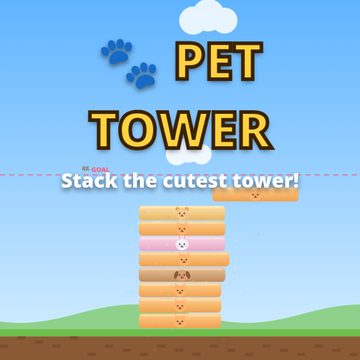 Pet Tower: Stack the PetsStack adorable pet blocks as high as you can — one tap to drop, nail perfect combos.